

AI Use Cases That Actually Pay Off in eCommerce
 By Sergii Anufriiev, Founder & CEO — 24 Jun 2026
Every week there’s a new AI tool promising to transform eCommerce. Most won’t. Not because the technology is bad—but because businesses expect AI to fix problems that already exist: poor product data, weak analytics, inconsistent processes, and unclear customer journeys. The brands seeing real ROI from AI aren’t the ones using the most tools. They’re the ones solving the right problem first.
Customer acquisition costs (CAC) are growing every quarter. Operational expenses are eating into your margins. During strategy planning, you know you need to optimize, and everyone around is shouting about Artificial Intelligence.
But let’s be honest: there is a lot of AI fatigue. Founders and eCommerce managers are tired of the hype. You do not want to invest time and money into a trendy tool that will break your current processes or annoy your customers. You are looking for clear, proven solutions that drive actual revenue.
Why Common AI Advice Fails
Most guides on the internet promise that AI will magically solve all your problems. They tell you to “automate everything” from day one. This is a dangerous trap. Implementing complex AI solutions without setting up basic analytics first is a guaranteed way to burn your budget. For example, adding a modern AI chatbot to a store with a messy product database just gives your customers the wrong answers much faster. Technology cannot fix a broken foundation.
In practice, most failed AI implementations don’t fail because the model is weak — they fail because the underlying data, tracking, and business logic are inconsistent or incomplete. If your product feed is inaccurate, your inventory mapping is broken, or your customer segments are undefined, AI simply scales that confusion instead of solving it.
Before introducing automation, teams should first establish:
- clean and structured product data (titles, attributes, variants, pricing logic)
- reliable event tracking (GA4 or equivalent with validated conversion events)
- clear decision flows (what should happen when a user asks, clicks, or abandons)
AI only becomes valuable when it sits on top of a stable system. Otherwise, it doesn’t reduce workload — it amplifies noise.
Data First, Tools Second
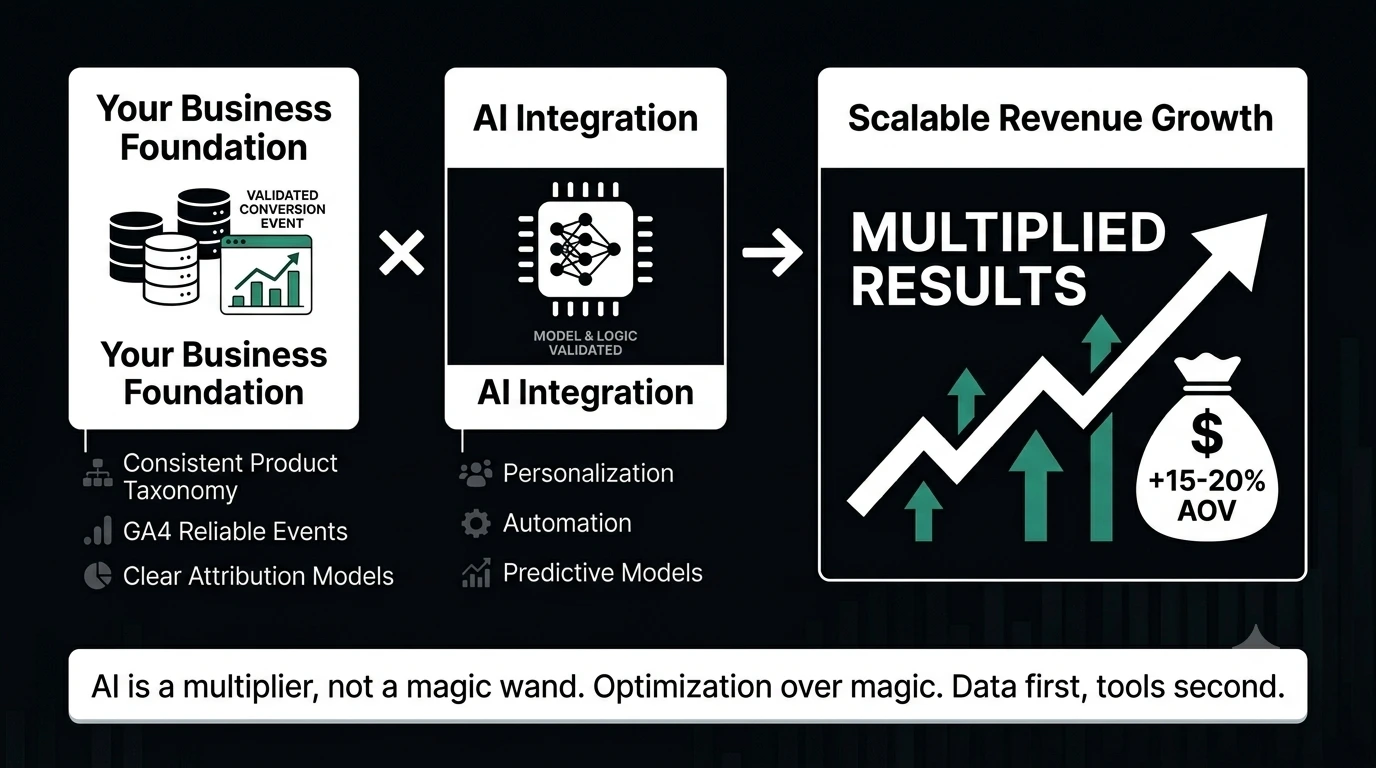
At URich, our logic is simple: AI is a multiplier, not a magic wand. It multiplies the quality of your existing processes. Before adding any smart algorithms, you need to make sure your data is clean and your store architecture makes sense. This means starting with fundamentals that often get ignored in the rush to “innovate”: consistent product taxonomy, reliable tracking events, clear attribution models, and a well-structured customer journey. Without these, even the most advanced AI stack will produce misleading outputs and poor decisions at scale.
We have seen businesses waste thousands of euros on AI features they did not need — not because the tools were bad, but because they were solving the wrong layer of the problem. In most cases, the real bottleneck was not automation, but fragmentation: disconnected data sources, unclear KPIs, and inconsistent execution across teams. Our approach focuses on fixing the core first. Only when the system is stable do we introduce intelligence on top of it — whether that’s personalization, automation, or predictive models.
If you need help structuring your eCommerce processes or optimizing your platform before scaling, you can explore how we build solid foundations at URich Business Processes. We focus on what actually works for your specific stage of growth.
What Works and What Doesn't
So, where should you actually spend your money? Based on real observations in the D2C and B2C markets, here is the truth about current AI tools:
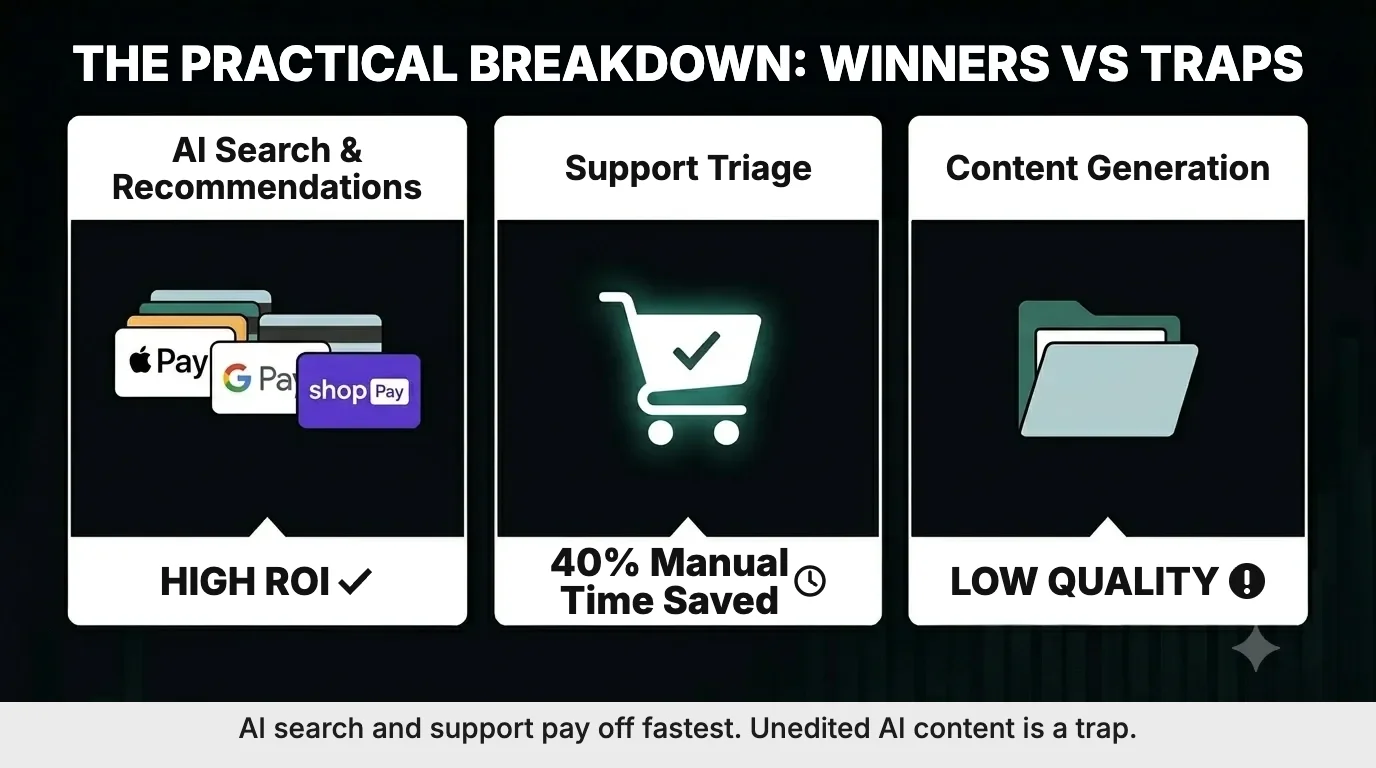
The Winners: AI Search and Personalization
Industry-leading solutions like Klevu, Algolia, or Nosto have proven that when site search shifts from basic keyword matching to semantic AI processing, conversion rates spike immediately. AI-powered site search and personalized product recommendations give the fastest and most visible ROI. When the system understands user intent, the results are clear:
- Faster discovery: Customers find what they want even with typos or broad synonyms.
- Higher AOV: Proper AI recommendations can lead to a 15-20% increase in Average Order Value.
- Lower bounce rates: Delivering relevant products from the first search or recommendation reduces frustration and keeps shoppers engaged throughout the buying journey.
- Better customer retention: Personalized product suggestions create more relevant shopping experiences, increasing repeat purchases and long-term customer lifetime value (LTV).
The Time Saver: Customer Support Triage
Deploying modern AI layers on top of platforms like Gorgias or Zendesk allows brands to filter out the noise. AI is excellent at handling routine tasks. Implementing smart support tools can transform your customer service by:
- Categorizing and routing support tickets automatically.
- Answering basic, repetitive questions (like "Where is my order?").
- Reducing manual processing time by up to 40%, freeing your human team for complex issues.
The Trap: AI Content Generation
Many stores try to use AI to write all their product descriptions and blog posts automatically. While it saves time, it brings significant risks:
- Boring, generic text that hurts your unique brand voice.
- Potential SEO drops due to unhelpful, mass-produced content.
- A constant need for heavy human editing to make the text readable.
Risks, Limitations, and Honest Warnings
AI is not a universal solution, and it is not the right investment for every eCommerce business. Its success depends on factors such as data quality, catalog size, traffic volume, and internal processes. Before investing in advanced AI capabilities, make sure your business has the foundation needed to generate meaningful results.
Common limitations include:
Limited data for AI learning
Stores with fewer than 100 SKUs or low monthly traffic typically don’t generate enough behavioral data for AI personalization or recommendation engines to perform effectively. In these cases, manual merchandising often delivers better results.
Unrealistic ROI expectations
AI is not an instant revenue generator. Most solutions require weeks or months of data collection, testing, and optimization before producing measurable business value.
Weak foundations produce weak results
If your product catalog, customer data, or analytics are inconsistent, AI will simply automate those existing problems. Clean data and reliable tracking should always come before automation.
AI complements people—it doesn’t replace them
Strategic decisions such as pricing, merchandising, customer experience, and brand positioning still require human expertise. The best-performing businesses combine AI automation with human oversight rather than replacing one with the other.
For many growing stores, investing first in CRO, site speed, product content, and high-quality photography will produce a higher ROI than implementing advanced AI features too early.

let's talk
Is your data infrastructure ready for automation? Implementing intelligent features on a messy backend will only scale your bugs.
AI Investment Priority Matrix
| AI Initiative | Business Impact | Implementation Effort | Recommended Stage | Core Dependency (Data Requirement) |
|---|---|---|---|---|
| AI Search | High | Medium | Early | Clean product taxonomy & tags |
| Personalization | High | Medium | Early |
High traffic (>50k monthly sessions) |
| Customer Support | Medium–High | Low | Early | Structured FAQ & Order Status API |
| Inventory Forecasting | Medium | High | Growth Stage | Multi-year historical sales data |
| AI Content Generation | Medium | Low | After Brand Guidelines | Strict prompt guardrails & human editors |
| Dynamic Pricing | Medium | High | Mature Business |
Real-time competitor pricing feeds |
SEO & Tech Depth
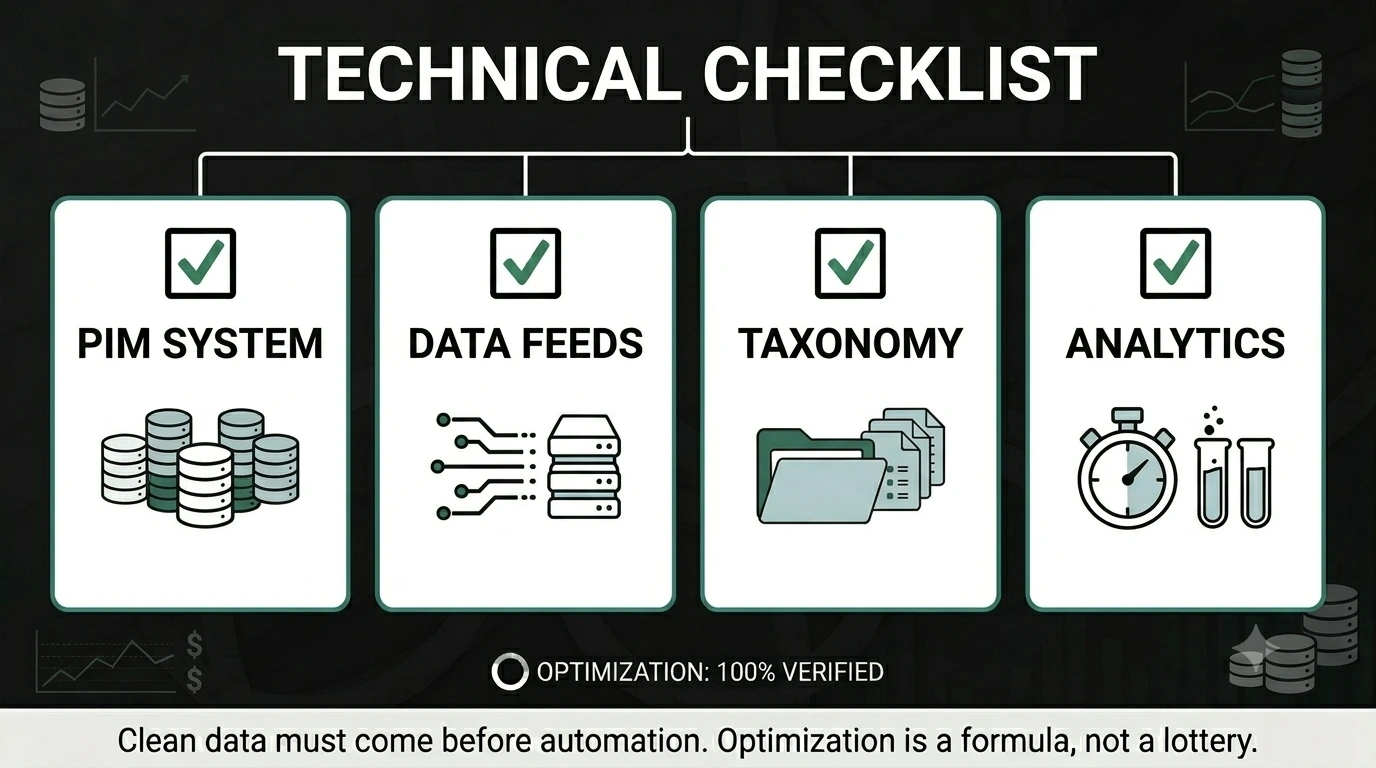
From a technical perspective, AI tools are only as good as the data you feed them. If your product tags are a mess, the AI will make bad recommendations.
You need clean, structured data to succeed. This requires:
A clear Product Information Management (PIM) system
Centralize and standardize product data across all sales channels.
Properly configured data feeds
Ensure accurate, up-to-date product information is delivered to AI tools and marketing platforms.
Consistent product tags and categories
Use a logical taxonomy so AI can accurately understand relationships between products and generate relevant recommendations.
Without this technical depth, even the most expensive AI software will fail to deliver results.
The Post-Launch Reality
What happens after you successfully integrate the right AI tools? Your team will not disappear. Instead, their daily routine will shift from manual tasks to strategic thinking.
Instead of manually linking “related products”, your managers will:
- Analyze data and monitor how the AI is performing.
- Tweak the rules and adjust algorithms for better margins.
- Focus on creative strategies to grow the business.
Where to Start
Do not try to implement five AI tools at once. Real innovation in eCommerce is about making calm, calculated decisions. Follow these simple steps:
Identify the bottleneck
If conversion is low, test AI search. If support is overwhelmed, look into ticket routing.
Choose one problem
Focus entirely on solving that specific issue.
Pick the right tool
Find software with a clear, transparent pricing model.
Measure the impact
Review the ROI and results after one month before scaling further.
AI Readiness Checklist
Before investing in AI, ask yourself:
- Is our product data complete?
- Do we trust our analytics?
- Can we measure success?
- Do we have enough traffic?
- Are we solving a real business problem?
If the answer to several questions is “no”, improve those foundations first.
The companies getting the highest return from AI aren’t necessarily the ones investing the most. They’re the ones with clean data, clear priorities, and the discipline to solve one business problem at a time. AI doesn’t replace operational excellence. It amplifies it.
FAQ
Generally, machine learning recommendation engines require at least 30,000 to 50,000 monthly unique visitors and a catalog of over 100 SKUs to accurately map behavioral patterns. For smaller stores, static, manual merchandising rules usually deliver a higher ROI.
Purely automated, mass-produced AI product descriptions can trigger Google’s “unhelpful content” filters, leading to drops in organic traffic. To leverage AI safely, use it to generate drafts, but always apply human editing to ensure your unique brand voice, accurate technical attributes, and localized SEO keywords are present.
The absolute priority is auditing your product feed and data tracking layers. Ensure your Google Analytics 4 (GA4) or server-side tracking captures clean purchase events, and that your Product Information Management (PIM) system outputs consistent titles, variants, and stock tags.