

AI Website Management: Pros, Cons, and What the Research Shows
 By Sergii Anufriiev, Founder & CEO — 22 Sep 2026
"AI writes your blog post" and "AI manages your website" sound like the same trend. They aren't. One is a content trick. The other changes who can ship a page, and how fast – and it comes with a very different set of risks.
Here's a grounded look at what AI website management actually is, what the research says about AI adoption versus AI results, and the real trade-offs – not just the upside – of letting AI touch a live website.
What Is AI Website Management?
AI website management is using AI to handle the day-to-day work of running a website – content edits, new pages, restructuring, SEO updates – instead of routing every change through a full design-dev-QA cycle. Someone describes the change in plain language, AI produces the structure and code, and a human reviews it before it goes live.
That last part is the whole point, and it's where most "AI content" tools stop short. There are two very different versions of this in the market:
- AI writes text, a person still manually rebuilds the page – the queue doesn't get shorter, it just gets an AI-generated first draft
- AI works inside the actual publishing pipeline – branch, preview, review, deploy – so the change itself ships faster, not just the first draft
Only the second version changes the timeline from weeks to hours. The first just moves the bottleneck one step earlier.
How It Actually Works
A properly built AI-managed workflow looks less like a chatbot and more like an engineering process with AI doing the manual labor:
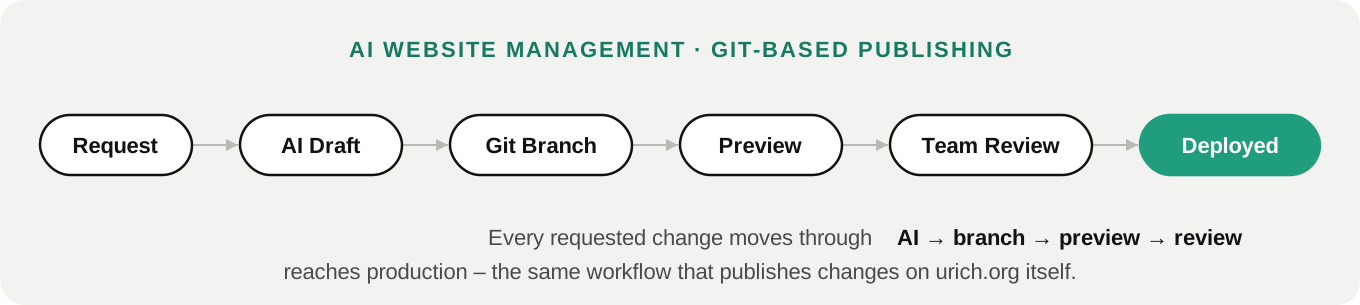
- Request – a team member describes the change in plain language
- AI draft – AI writes the page, copy or structural change using the site's existing components and design rules
- Git branch – the change lands on an isolated branch, never straight to production
- Preview – the team sees the change live, on a real preview URL, before anyone signs off
- Review – a human approves, edits, or rejects the change
- Deploy – only approved changes go live, with a full history and instant rollback
Remove any one of the review steps and you don't have "AI website management" – you have an unsupervised script pushing to production, which is a very different (and far riskier) thing.
The Pros
Hours, not weeks
Small content changes – a new offer, an edited page, a published case study – can go from request to a reviewed, live page within hours instead of sitting in a dev queue.
Fewer developers in the critical path
Routine content and page changes stop competing with "real" engineering work for the same developer time.
Content stops piling up
Case studies, blog posts and SEO pages get published on a real schedule instead of sitting in a backlog waiting for capacity.
Full audit trail
Every change lives in Git – who requested it, what changed, who approved it – with the ability to roll back instantly if something's wrong.
What the Research Actually Shows
The honest picture is more nuanced than most "AI will change everything" posts suggest – and the gap between adoption and results is the real story.
- Adoption is mainstream, results aren't automatic. In McKinsey's State of AI survey (November 2025), 88% of organizations say they use AI in at least one business function, up from 78% a year earlier. Yet only 39% report any impact on EBIT at the enterprise level, and only about 6% qualify as "AI high performers" – companies that attribute more than 5% of EBIT to AI.
- The gap is the workflow, not the model. The same survey found that high performers are nearly three times as likely as other companies to have fundamentally redesigned individual workflows – and that this redesign is one of the strongest contributors to real business impact. Bolting a chatbot onto the same old queue doesn't count.
- Search engines don't penalize content for being AI-generated. Google's Search Central guidance (February 2023) is explicit: Google rewards high-quality content however it's produced, judged by helpfulness and E-E-A-T (experience, expertise, authoritativeness, trustworthiness). What breaks its spam policies is using automation – AI or not – to mass-produce pages mainly to manipulate rankings.
The search side is changing too: AI assistants now read, quote and recommend websites directly. We measured what that looks like on our own site in our GEO case study – and a site your team can update the same day is a site you can actually keep current for both Google and AI search.
The Cons and Real Challenges
Unsupervised AI on a live site is a real risk
Language models can generate confident, plausible, and wrong output. Without a mandatory human review step before deploy, that risk lands directly on your live site – broken layouts, incorrect claims, off-brand copy.
It needs a modern technical foundation first
AI can't safely manage a website that isn't structured for it. A site without version control, components, or a preview environment has to be migrated onto that foundation before AI-managed publishing is even possible.
Content quality still depends on editing
Google judges content on helpfulness, accuracy and original insight, so AI-drafted pages still need a human editing pass. Publishing AI output unedited is a search-visibility risk, not a shortcut.
Not a fit for every site
Complex transactional stores – checkout logic, customer accounts, warehouse or ERP integrations – carry a different risk profile than a content-driven business site, and need dedicated engineering, not AI-managed publishing.
Governance takes real setup
Access control over who can request and approve changes, documented design rules for the AI to follow, and automated pre-deploy checks aren't optional extras – without them, "AI-managed" quietly becomes "AI-unmanaged."
Is Your Website a Good Fit?
AI website management earns its keep on sites that publish and change content often. It's a weaker fit where the risk of an error is transactional, not editorial.
| Good fit | Not the right fit yet |
|---|---|
| B2B, agency & consulting sites | Complex eCommerce with customer accounts |
| SaaS marketing sites | Stores with complex checkout/payment logic |
| Healthcare, education, real estate sites | Sites needing warehouse or inventory accounting |
| Sites running active blogs & SEO content | Large catalogs with high order volume |
| Businesses running frequent ad campaigns | Sites with deep ERP integrations |
If your site sits on the left, the constraint is usually process, not technology – and that's a solvable problem.
The Honest Takeaway
AI website management isn't magic and it isn't hype – it's a workflow change. The adoption numbers say most businesses are already using AI somewhere. The performance numbers say most of them haven't touched the actual bottleneck: the process a change has to survive before it goes live. Fix the workflow, and AI genuinely gets pages out in hours. Skip that, and you've just added a faster way to write drafts nobody ships any sooner.
We rebuilt our own site, urich.org, on exactly this model after a traditional redesign took months and still missed its deadline – so we could stop guessing and run the process ourselves. Our AI Website Management service starts with an audit that tells you honestly whether your site is ready for it.

FAQ
No. Properly built AI website management always includes a Git branch, a live preview and a human review step before anything reaches production.
Not for being AI-generated. Google rewards helpful, original content however it's produced. The real risk is thin, unedited pages mass-produced to manipulate rankings – which breaks Google's spam policies regardless of how it was written.
Most business sites need a transition first – moving onto a Git-based, component-driven foundation – before AI-managed publishing can run safely on top of it.
A focused transition – migrating an existing site and setting up the Git-based publishing workflow – typically takes a few weeks, depending on the current stack and the size of the site. The audit gives you a concrete plan, cost and timeline first.
No. It removes developers from the path of routine content and page changes, so they're free for work that genuinely needs custom engineering – complex integrations, new components, architecture changes.